Showing posts with label Travel_in_Japan. Show all posts

Travel in Japan: Kumano Kodo

August 10, 2016 0


Kumano Kodo, "Kodo" literally means "ancient road". The road is a convergent one, there are several starting points of the road but the destination is one, Kumano Shrine. The treks are lying on Kii Hanto Peninsula, mountainous area, about 3 hours south from Osaka by car.
The routes were formed about 1000 years ago. The shrine was quite popular and many Shintoist went through the routes despite its location.
However, nowadays the treks get attention not only from religious people but also for hikers due to its view and rocky road. I'm one of them, I trekked for 3 days. You can enjoy splendid scenery and fresh air in the heart of forest mountains.


Thanks Monique!


Japanese restaurants; What I ate recently

May 31, 2016 0
I have no suitable idea for Lang-8, so I don't know if this is interesting to you or not, I'll just be writing about what I ate recently in Japan.
It's like almost diary.

-May 13th
-Curry rice (Curry and rice)
Curry is obviously an Indian food but I heard it's a particular thing that putting the curry on the rice.
I had it in a small restaurant at a station at 6 am.
As a general rule, Japanese people are fond of curry with rice, but it's rare that a place serves curry in the early morning.
An ingredient was beef but it only had small pieces.
You can put as many pickles on it as you want.
It costs about 4 dollars.


-May 14th
-Cutlet with cheese and garlic sauce
If I'm correct, it was an Italian restaurant but I'm not sure whether the dish was Italian or not.
Restaurants in Japan tend to put every Western food, such as Italian, French, Spanish food and so on, together.
It's called 洋食屋, the literally translation is "Western food restaurant". I think it's similar to things that Thai ,Chinese or some restaurants  offer Japanese food overseas.
The picture makes my mouth water. The cutlet was tender and had cheese on it which added a rich flavor.
It costs about 11 dollars, and includes a salad and soup.

I think the restaurant should replace the tablecloth with checked patterns. It looks a bit shoddy.


-May 9th
-A potato croquette
My mom bought it at a supermarket.
What I was surprised by was its price, 18 yen (16 cents) for one.
She somewhat boasted how she was good at shopping.
Despite the wonderful affordability, it was tasty.


Thanks for Lee's revision.

A 100 yen shop: a dollar store in Japan again

May 25, 2016 0


A 100 yen shop, where everything is sold at 100 yen (now it's $0.91), is drawing more and more attention, or I should say that it's already a common thing for Japanese people.
Several 100 yen shop chains are always in severe share competition with each other. That is because of the nature of the business in which they are easy to be substituted by customers for other competitors. They keep expanding their selection.

Let me show you some items that surprised me.

First, nail polish. When I visited Toronto, I was surprised that a lot of nail salons were running along Yonge street.
What a lot of selections! I've never browsed the cosmetics section before, but there is a quite rich selection. Apart from normal color nail polishes, they even have assorted lame (shiny) nail polishes. I didn't expect this kind of things to be sold for 100 yen, but come to think of its manufacturing costs, cosmetics are likely to be sold in 100 yen shops.

Second, chair legs' covers. I found them a furniture protection section. It was a surprise to me, because my house doesn't have chairs which need these kinds of protectors. I live in a pure Japanese style house, in which Tatami mats are laid in all rooms, so it's difficult to put chairs.
What a large selection, while I don't even have a single chair

Third, Japanese fans. Oh my. They definitely look more valuable than a 100 yen. I'm scared of their ability to develop items.
Please feel free to ask me to bring them as a souvenir for you if I have a chance to visit your country.
Presumably, I think I can sell them at like 5 dollars overseas and make a profit.
Is that a good idea?


Extraordinarily expensive water in airports

May 22, 2016 0
Water in a airport is extraordinarily expensive.

I've been to airports in several countries, and I've noticed that beverages are always extremely costly.
Passengers are not allowed to bring liquids beyond the security checkpoint, so beverages are at higher prices within the security area.
It's about twice the normal cost.
I know that this is the nature of  business but I can't help feeling that I'm being exploited.
I have seen bottles of water sold for more than 3 dollars each.

On the other hand, I wasn't too bothered to see a bottle of water for sale in an airport in Tokyo at price which was only 1.13 times that of the normal price. (The normal price is 118 yen, but it was selling for 133 yen)
Compared to prices of bottled water in other airports, It was a very modest price.
I'd say it's too modest. Why didn't they set a higher price?

I'm curious as to what price would lead to the highest profit.
If price is too high, passengers will avoid buying bottled water, but if it is too low, the seller would lose potential profits.

In any case, I'm determined not to buy bottled water if it costs more than 2 dollars.

Thanks Deanfujioka!

ATM with recognition system.

May 22, 2016 0
This is an ATM in a Japanese post office.
The Japanese Post Service also runs their own bank, so every post office has its own ATM.
Approximately 10 years ago, the ATMs had finger vein recognition system installed. However, it's not precise or convenient to use because you may try to have your finger recognized again and again.

Sometimes I get through it on the first attempt, but not usually. It's so finicky
registering your finger vein pattern, unlike on the iPhone6. I’ve never seen people using the system aside from me.
I guess the Post Service wants to renew the old system but they will be not able to do that because there aren't many current users.

How about installing an iPhone on that ATM?

Thanks for Jess's and Madox's correction.

A 100 yen store: a dollar shop in Japan

May 21, 2016 0


It was not until I went abroad that I noticed there are 100 yen shops abroad.
In this kind of shop, everything is sold at 100 yen, or a dollar in North America. (1 dollar is 109 yen in today's exchange rate.)
I had heard that the prices in North America is quite high, so I assumed the shop was only in Japan and I was surprised to find it in Canada.
However, I noticed the selections in the shops is in Japan and overseas are different.

I went to a 100 yen shop for the first time in a while, and I was surprised to see the selection in a 100 yen shop from the perspective of a foreigner.
Let me show you some picture I took in the shop.

First, the abovepicture. I couldn't help laughing when I saw so many kinds of insoles there. Do so many people need insoles in 100 yen shops? It seems they have ones for leather shoes, running shoes, women's shoes, and ones with aroma and others. Because of the price, you can change your insoles frequently. However, I don’t think their quality is very good… Though I haven't used them before, so I don't know their quality.

Secondly, in the middle picture, there is a set of precision screwdrivers. It's surprising they have such a thing. Sometimes it's needed but I often only have big screwdrivers on hand.
It’s expensive if I buy it from the usual store, so I leave screws loose, occasionally.
Now I know I can buy them for a dollar, so I can tighten the screws anytime. After that, I will probably lose those screwdrivers too. It seems I have to organize my tool box. It seems I have to put together a tool box.

Thirdly, in the following picture, there are flip-flops. I was shocked to see them because I bought the cheapest flip-flops in a store in the Philippines, but it cost about 4 dollars. What is more, they look better quality than my flip-flop. It shocked me. I almost bought it but I decided to keep using my flip-flops.
I'm a bit skeptical that they can make them with under a dollar including all costs. How much profit does the manufacturer earn? It raises me a lot of questions…


 Thanks for MarkMcP's correction.


A budget food in Japan: Udon

May 17, 2016 0
Do you have the image that Japanese food is expensive? If you visit Japan, I bet you'll have another idea.
If you want to have a budget lunch in Japan, you might want to go to an Udon shop.
Udon is a Japanese traditional-styled noodle. Nowadays, Ramen has gained worldwide popularity, but Udon is not yet popular abroad. I would say it's an up-and-coming Japanese food.
The noodles in Udon are elastic, harder and chewier than Ramen's. Japanese people enjoy their texture. The food is made very simple. They serve soup in a bowl, and put the excellent noodle in it, and voila, that's it. 
Because of its simplicity, it's cheap like 3 dollars and cooked fast.


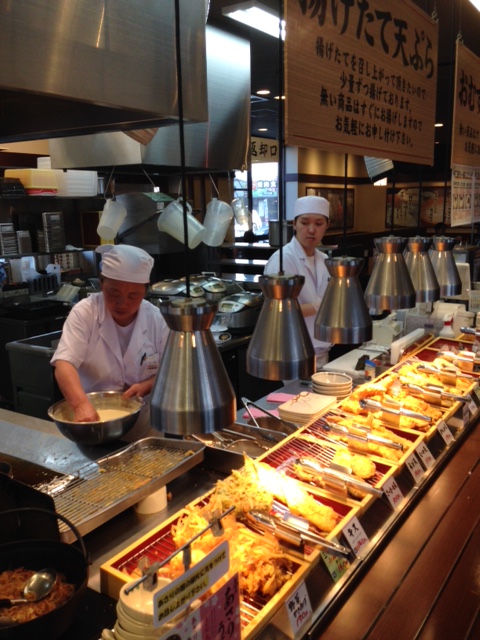
The above pictures are taken at an Udon shop in my area. You can see green onions and tempura-ish things in serving trays along with the Udon. They are important ingredients for Udon, they make Udon more delicious. As you see, you can add them as much as you want. You will be attracted by various tempuras such as vegetable, fish, and meat tempuras in an Udon shop. Each tempura costs about a dollar. You should be careful to have tempura too much. You'll gain weight. I don’t know why Udon shops usually serves tempura as well. You can see the following picture.

*In the above picture, I ordered Kake-udon which cost 290 yen ($2.7).

Lemon curry?

May 15, 2016 0
When hanging around a town or somewhere in Japan, I noticed something that I didn't realize before I left Japan. This time, I'll introduce that.

This is a Curry-Meshi, a popular instant food which you can cook curry with rice by just putting into a microwave oven. It seems they have produced a new product. The new products are on the left side of the picture. It indicates "Lemon cream taste". It's unbelievable for me that curry and lemon cream are combined to make them delicious. However, it also has irresistible attraction because of originality. Who proposed to produce this? Just a thought, is the taste is inspired by Monty Python? I admire him.

*I checked to see if lemon curry exists, and it does.there is. I'll apologize to lemon curry.
*It costs about \200.

Thank you for kierstynnf's correction!

Travel in Japan: Tottori, temple on precipice

March 09, 2016 0
Today, I'll show you a place to visit in Tottori, which is one of the least famous areas in Japan!
Tottori, the area which can be forgotten by Japanese people. A survey clarified that only 40% of junior high school students know where Tottori is. Despite the popularity, the area has magnificent sceneries, ancient hot springs, delicious seafood and so on. 

Nageire Dou temple, this temple is built on the middle of a precipice. A temple in such a dangerous place is unusual even across Japan, and the exact way it was built is still enveloped in mystery.
What's even more interesting for you is the way to get to the temple. As you know the temple is in a steep mountain, which is the sacred area of the temple. Due to the danger in the mountain, wearing usual shoes is prohibited. You have to wear mountain boots, or Waraji.

Waraji!? 
What I want to show you is Waraji.

Waraji are Japanese traditional sandals that are made up of straw ropes. It was used in the past, if you've seen Japanese historical dramas, you must have seen these sandals on people's foot. Surprisingly, wearing Waraji is advised to climbed up the mountain. I ensure that you'll never have such an experience except here, Nageire Dou. You might be worried whether Waraji work or not on steep mountain trails, however, in my experience, it keeps you from slipping.

I recommend it to you who don't like to go to major attractions, you can be relieved; no foreign tourists there (First of all, perhaps no foreigners in Tottori... kidding. 80 people from Canada enjoyed Tottori in 2015 according to the data).
By the way, you can't enter during winter and when it's raining due to the risks of slips.

Where is the temple? Although the temple is on a cliff, it is easier to access than you'll expect.

When you stay at Tami: a hostel I love inTottori ($28), it will take 10 minutes to get to Kurayoshi Station, and 40 minutes by bus to the temple.

Thank you for the correction, Gjay

Travel in Japan: Kagoshima, great caldera in Mt. Kirishima

March 06, 2016 0

Actually, Japan is larger than you thought. The picture above is obviously Japanese scenery, I took it when I climbed up Mt. Karakuni, which is part of Kirishima mountain range. The mountains are located across the Kagoshima and Miyazaki area, but it will be easier to access from Kagoshima.

Kagoshima is the southernmost area in Japan, it's quite far from Honshu island.
It takes four hours from Osaka by Shinkansen. It costs about $200 but you don't need to worry if you have a JR pass. You can get to Kagoshima easily but going Kirishima mountain range requires taking a bus or renting a car.

You can see an overwhelming crater, or caldera, when you climb up the mountains. You won't notice it is the sign of an eruption due to the unusual size. Indeed, the mountain range has been continuing its volcanic activity, thus some of the mountains are prohibited to enter. If you look back when you are climbing up, you'll notice you are in the line of volcanoes. You wouldn't forget the scenery there.
And one more thing, the local dishes in Kagoshima are the greatest. You should try them even if you aren't interested in the volcanoes.


Travel in Japan: Kagoshima, great caldera in Mt. Kirishima

Travel in Japan: Kagawa, delicious udon, and an ancient temple

Travel in Japan: Beppu, Hot Spring

Japan Rail Pass (You can take almost any train in Japan)
Thank you Beelzebubbles, Kenji, and Madox!

Travel in Japan: Kagawa, delicious udon, and an ancient temple

March 04, 2016 0
I'd like to tell you about tourist spot in Japan that are off the beaten path.
This time, I'll introduce Kagawa.
Kagawa is located in the Shikoku area, in the Southeast part in Japan.
It takes two and half hours from Osaka. (One hour by using Shinkansen with a transferring at Okayama, another one and half hour by JR express and local JR trains.)

Shikoku is one of the four big islands in Japan, separated from Honshu (Mainland) by the Seto inland sea. Shikoku and Honshu are connected by a huge bridge, so you can go over the bridge and enjoy the island scenery when you visit Shikoku. Kagawa is located in Shikoku's inland sea side, so it's relatively easy to access compared to the other regions of Shikoku.
Kagawa is famous for Udon, Japanese noodle. Nowadays Ramen is getting popular abroad, but Udon is little different from Ramen; its attraction is in its their texture. The texture is called "Koshi", and it's very elastic and smooth. It's like..like..no idea, sorry. It just made my mouth water. I guess some people have already had Udon before, but I have good news: Kagawa's udon is way better than ordinary udon.
Kagawa's udon evolved independently, and no other udon can compare Kagawa's. Furthermore, even the tastiest Udon is much cheaper in Kagawa than that in other areas; about one to five dollars. There is no disagreement that Kagawa is the Udon kingdom in Japan.

If you are interested in Kagawa, I recommend the Kotohira region. There is an ancient temple on one of  the mountains. The temple is at the top of the some long, long stone steps - more than 1300 steps in total. There is an array of souvenir shops that have unique stonework, woodwork and whatnot, and there are local snack shops on both sides of the stone steps. After eating some of the unique food there, you can enjoy exercising on the old steps, so you can see beautiful scenery from the mountain. I also love Kagawa's sake, fish, cafes, and museums, maybe I'll talk about that some other time.


I appreciate Blah's correction.


Travel in Japan: Beppu, Hot Spring

March 03, 2016 0

I'd like to tell you about off the beaten path tourist spots in Japan.
This time, I'll introduce Beppu.
Beppu is located in Kyusyu area, the Southern part in Japan.
It takes 4 hours from Osaka, 2 hours by Shinkansen and transfer at Kokura, then 1 hour by JR express.

The town is famous for hot spring, said to be one of the greatest hot spring area in Japan. You may see raising steam from here and there as you arrive Beppu. The steam is from hot spring heat, and there are more than 2000 hot springs in the town. It's well known not only for the quantity but also variety, and there are different benefits of hot springs.
Hot spring is also the place to visit, which you can see unusual view such as red hot spring, blue hot spring, etc. The hot springs are called Jigoku (hell in English) because of its scenery which has strange color of hot water (not artificial), rocks, rising steam.

As I said, there are hot springs everywhere, so the steam is used for cooking as well. Some hotels have a steam cooking spot with steam jetting out without a pause. The cooking spot is usually outside, so you can enjoy steam-BBQ! You can steam whatever you want! Actually, steam cooked vegetable, sea shell, and local raised chicken, anything is at least two times delicious than usual when you cook them by the steam. If you put Yuzu-kosho, sour and hot local special spice which mixed citron and blue pepper, on steam cooked food, I have no words to explain how delicious it is.
Also the town is close to the sea, so fish, including sushi is excellent. In my experience, beef, pork, and chicken are outstanding, furthermore not expensive.
Why not. No reason not to go.


Travel in Japan: Kagoshima, great caldera in Mt. Kirishima

Travel in Japan: Kagawa, delicious udon, and an ancient temple

Travel in Japan: Beppu, Hot Spring

Japan Rail Pass (You can take almost any train in Japan)

Thanks, Elly!

Japan Rail Pass (You can freely take almost any train in Japan)

February 11, 2016 0
If you are interested in visiting Japan, the following information will be useful.
Have you ever heard of the "Japan Rail Pass"?
It's a kind of discount pass for railway in Japan, which enables you to take any Shinkansen(bullet train in Japan) or regular JR trains. 
They offer 3 types of tickets, CA$360/ 7 days, CA$770/ 14 days, and CA$1100/ 21 days respectively*. 
You may find that to be a little expensive but actually it's absolutely affordable and efficient. Of course if you plan to visit only Tokyo, it would be too expensive. But if you want to go to Tokyo and Kyoto, or Tohoku(the northern area), or Kyushu (the southern area), it would definitely pay itself off. Roughly speaking, the 7-day pass costs almost the same as going round-trip from Tokyo to Kyoto by Shinkansen. In addition, I want to emphasize that you can visit wherever you want by using this ticket, because the JR train system which includes the Shinkansen extends across Japan. 
It doesn't require you to have a reservation, so this could free up your travel. If you hear about a hot spring in Kyushu, you can go to Kyushu the next day with the pass.
If I were to visit Hukuoka, Kagoshima, Okayama, Niigata, Yamagata and Tokyo in 7 days by Shinkansen, it would cost over CA$1000. I could save almost CA$700 if I had the pass, so I want it, but Japanese can't buy it! 
I'm guessing it's probably because the pass isn't profitable for JR. I think the railway company receive subsidies from the government to offer the pass in order to encourage foreigners to visit Japan. It's a good deal, so you should take advantage of the pass when you visit Japan.


* The stronger the Canadian dollar gets, the more cost effective it is.
*CA$ Canadian dollar